

Quantifying How Poorly the Devils Have Drafted in the First Round Under Tom Fitzgerald
Tom Fitzgerald became the General Manager of the New Jersey Devils prior to the 2020 NHL Entry Draft -- is the reputation of being a poor drafter warranted?

Thank you, as always, for reading the Devils’ Advocates Substack! If you enjoy the quasi-daily content, please consider subscribing and sharing with your friends, family, and any Devils fan you know. It is completely free of charge and helps out quite a bit!
Recently, we reignited the Devils’ Advocates Podcast, which will feature weekly episodes chock-full of in-depth content and exciting guest appearances. They’ll be available on this Substack, but you can also listen on your favorite platforms at the following links:
If ever there has been a critique of Tom Fitzgerald’s tenure as New Jersey Devils GM that has not flown under the radar, it’s the perception of how he has drafted over the years — dating back to his first draft in October of 2020.
This season, it came into the limelight once more when the Devils failed to acquire generational defenseman and brother to New Jersey’s two franchise pillars, Quinn Hughes. The Devils were ultimately bested by a Minnesota Wild offer that included Zeev Buium and Marco Rossi as the main pieces of the trade, both of whom were players selected two picks after the Devils drafted Anton Silayev and Alex Holtz in their respective draft years.
Fitzgerald’s draft record in the second round and beyond is more or less fine. By that, I mean that the probability of a draftee turning into an NHL-caliber player generally drastically diminishes in the second round and beyond, and, to be frank, the Devils have drafted two NHL-caliber players (Lenni Hämeenaho and Seamus Casey) in the second round. New Jersey has not hit on any third-rounders in recent memory, and any draftee in the fourth round and beyond is typically some form of dart throw.
The first round resume, however, is outright putrid.
Yes, the appeal is obvious with Luke Hughes and Simon Nemec, fourth-overall and second-overall selections, respectively, but the truth is that neither player has lived up to the expectation of a typical fourth or second-overall pick. Not every development arc is the same, to be clear, but to say they have been as advertised, or even close to advertised, outside of atypical stretches of play is undeniable.
In true Devils’ Advocates fashion, the best way I can illustrate this is in quantifiable numbers, particularly Wins Above Replacement (WAR), an all-encompassing metric that combines a plethora of data to illustrate how many wins a player is worth. Firstly, let’s start with the overarching five-year draft window that Fitzgerald has overseen, as it compares to the rest of the league:
In this five-year span, the Devils have totaled seven first-round picks: Alex Holtz, Dawson Mercer, Shakir Mukhamadullin, Luke Hughes, Chase Stillman, Simon Nemec, and Anton Silayev. The average pick was taken at 8.7th overall, which is the second-lowest mark in that span (Seattle, 8.4). That is to say that the Devils, theoretically, should be getting some of the best quality of player on the aggregate as it pertains to their first-round pick value.
Those seven players, in their NHL careers, have totaled 4.68 WAR, according to HockeyStats.
Compared to the league-average total WAR, the Devils are behind the eight-ball, as the average total WAR of first-rounders in the last five years for the other 31 NHL teams is 5.31.
Let’s narrow it down to teams that have averaged a top-half pick per first-rounder in that span, as a player selected in the first 50% of the first round is, typically, much better set up to be a quality player:
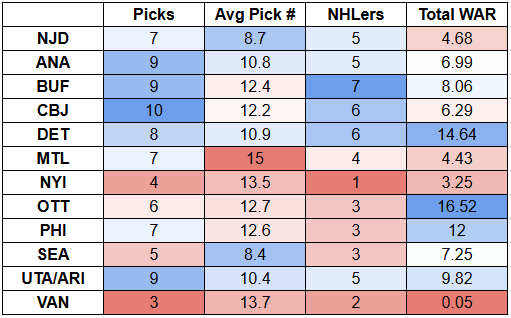
As you can see, in the last five seasons, the Devils have drafted at or above the frequency of the other teams in this pool, only with significantly better average selection spots than everyone except the Kraken, who only have four drafts to pull from. Yet, the Devils’ total WAR from their first-round selections is fourth-lowest among 12 teams. In fact, when digging a little deeper, things only look worse for New Jersey.
One team below the Devils in drafted WAR from the first round is the New York Islanders. Three of their picks were in the 2025 NHL Entry Draft — one being Matthew Schaefer, who is the only player on the list to have made the NHL in any capacity. Firstly, his WAR alone from just this season nearly matches that of all 1,011 games that the Devils’ first-rounders have combined for since 2020. Secondly, that will only compound once Kaishawn Aitcheson, Victor Eklund, and Cole Eiserman inevitably make it to the NHL.
On a similar token, Montreal’s first rounders have combined for 596 games — 415 fewer than New Jersey — and yet their total WARs are nearly identical. As for the Canucks, well, there’s no real excuse there yet.
So, just to summarize the entire scope of the Devils’ first-round picks over the last five years in a single sentence:
Despite picking in slots higher than all but one team in the NHL over the last five seasons, with an above-average number of draftees in that span, the per-game impact of their first-rounders is significantly worse than every team that has picked in the top half of the first round except the Vancouver Canucks.
Now, let’s get into some specifics, in chronological order.
2020
There are no complaints from me about the Devils selecting Dawson Mercer at 18th overall in the 2020 NHL Draft. In fact, Mercer accounts for a whopping 3.49 of the Devils’ total of 4.48 WAR from their first-rounders. 77.9%.
I’ll even omit Shakir Mukhamadullin from blame, since he was used as a predominant piece in the trade that brought Timo Meier to New Jersey. That simply leaves Alex Holtz as the whipping boy for the Devils’ draft struggles in 2020. To show just how poor the selection has panned out over the years, I’d like to illustrate how he compares to the seven players that immediately followed him in the draft order:
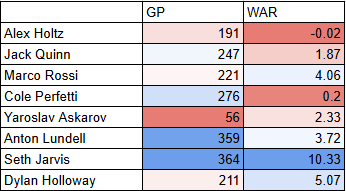
The only player to appear in fewer games than Holtz over this span is a goaltender, and one who is trending toward being a workhorse starter on a very talented, very young, up-and-coming Sharks team. Of course, featured on this list is Q. Hughes centerpiece Marco Rossi, current Panthers first-line stopgap Anton Lundell, and Team Canada selectee (and fourth-best player in the draft class) Seth Jarvis. Dylan Holloway’s career WAR surpasses that of all seven Devils’ first-rounders since 2020.
I know I said that I would omit Mukhamadullin from this tirade, but I do just want to highlight the putrid talent identification from Fitzgerald and the scouting department with that pick — immediately following him was Egor Chinakhov, Hendrix Lapierre, Tyson Foerster, Connor Zary, Justin Barron, and Jake Neighbors. The worst player on that list, Lapierre, has played nearly 100 more NHL games than Mukhamadullin, while every player outside of Lapierre has more than quadruple the WAR of the former Devils prospect, with Foerster having exactly 12 times the total WAR (5.28 - 0.44).
2021
There is no denying the obvious eye-test strengths of Luke Hughes’ game, and while I do ultimately believe he will turn into a special player (or at least a good top-four defenseman), the fact of the matter is that, right now, he does not profile particularly well in relation to the five players who were picked immediately after him:
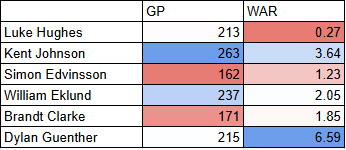
The only two players who have logged fewer games than Luke Hughes from the 2021 NHL draft class are Simon Edvinsson and Brandt Clarke, both of whom are playing like bona fide top-four blueliners on their respective squads. Edvinsson has been a staple alongside Moritz Seider on the Red Wings’ top pair, where he has generally sported positive two-way results, and Clarke is the single most underutilized defenseman in the league, whose underlying impacts are impeccable but whose reputation as a one-way defenseman have hampered his playing time.
The three forwards picked directly after L. Hughes have made significant impacts to their teams in at least one season. Kent Johnson has been a scratch at times this season, but was a near-point-per-game player last season while in the midst of the only season in which he was given top-six time. William Eklund has obviously been a mainstay in the Sharks’ top six, providing positive offensive value and recently scoring one of the most iconic goals of the modern era. Dylan Guenther needs no introduction, as one of the most impactful young forwards in the entire NHL.
Of course, as mentioned before, L. Hughes has the obvious eye-test aptitude and will most likely blossom into a player worth somewhere near his draft slot. For now, though, the impact just hasn’t been there, and, considering both where he was drafted and who immediately followed him, should have had this impact by now.
Him getting picked fourth overall doesn’t hold a candle to the Devils’ second first-round draft pick of this class, though.
Let’s briefly talk about Chase Stillman and put him alongside some names who were picked in the late-first or early second-round of the same draft:
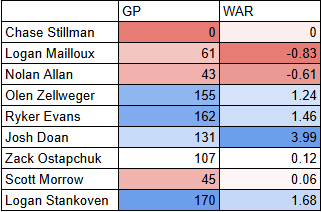
Stillman has not played an NHL game in his career and is most likely never going to — it was an inexplicable reach at the time and, quite frankly, has had zero impact on the organization other than being a minor piece in the trade that brought Cody Glass to the Devils. Following him was Logan Mailloux, who was traded one-for-one for Zac Bolduc (who has been excellent in a middle-six capacity throughout his career), Nolan Allan, who has been a bottom-sixer for the Blackhawks, and a plethora of positive-impact NHLers.
The early-second-round run of Olen Zellweger (who was my preferred choice at the time), Ryker Evans, and Josh Doan stings significantly when comparing them to who the Devils actually added, as all three have not only been long-time NHLers at this point, but impact players. Zack Ostapchuk is a bottom-six player, Scott Morrow was used as one of the bigger trade chips in the trade that brought K’Andre Miller to the Hurricanes, and Logan Stankoven is both an excellent second-line player for Carolina and was a predominant piece in the trade that sent Mikko Rantanen to Dallas.
By every measure, the Stillman pick was a brutal, brutal choice by Fitzgerald and the scouting department.
Then, of course, there’s 2022.
2022
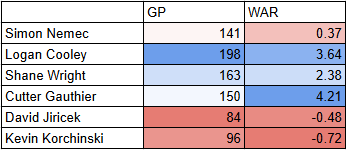
I hold a similar opinion of second-overall choice Simon Nemec that I do of L. Hughes: he will be an impact NHL defenseman, but simply has not held up his end of the bargain of being a second-overall-caliber player yet. His offensive instincts are phenomenal, and he has been clutch at several points of the season, but his defensive game needs a ton of work and he has more or less been a wash in his career so far.
Immediately following him were Logan Cooley, Shane Wright, and Cutter Gauthier, three forwards who are top-nine players for their respective teams. Cooley and Gauthier are the obvious standouts — Cooley is quickly turning into one of the best young players on one of the best young teams in the NHL, and Gauthier is likely to surpass 40 goals this season for the Ducks. Shane Wright’s two-way game is strong, and though he hasn’t shown that explosive play ability he did prior to his being drafted, has blossomed into a legit middle-six center for Seattle.
I included David Jiricek and Kevin Korchinski just because I wanted to include the five names immediately following Nemec, just as I did with Luke. Neither player has worked at the NHL level, though Jiricek was traded two times: one brought Daemon Hunt and four draft picks to Columbus (a first through fourth), and the other brought Bobby Brink, a young, middle-six forward, to the Minnesota Wild. Korchinski, well, hasn’t brought it yet.
Overall, while I think the consensus is that the Devils have not drafted particularly well over the years, I’m not sure the masses understand just how quantifiably poor their first-round choices have been.
Even their 2024 selection, Anton Silayev, simply has not improved year-over-year since being drafted in the facets of his game that most need improvement. Meanwhile, Buium was a core piece to the Quinn Hughes trade and Sam Dickinson looks to be a top-four defenseman for the Sharks for the long haul. Konsta Helenius will be a top-nine player for Buffalo for quite a long time, and Michael Brandsegg-Nygard should be a strong middle-sixer for the Red Wings to boot. Of course, only time will tell with that one, but their 2024 choice is already looking pretty bleak compared to the competition.
Imagine a world in which the Devils drafted Marco Rossi, Seth Jarvis, Anton Lundell, or Yaroslav Askarov over Alex Holtz. Imagine a world in which the Devils selected Josh Doan, Logan Stankoven, or Olen Zellweger over Chase Stillman. Imagine a world in which the Devils selected Zeev Buium over Anton Silayev. Imagine a world in which Luke Hughes and Simon Nemec have lived up to the expectations and performances of their pedigree and the players that followed them in the draft.
A moot endeavor, to be clear — the Devils made the picks that they did and reminiscing on what could have been is a one-way ticket to being agitated — but something that should be discussed. New Jersey’s draft efforts simply have not panned out as they should have. If they did, there is likely a legitimate conversation about how they 1) would have landed Quinn Hughes in a trade and 2) would be in a much, much better place both now and in projection.
Well done. Let's assume for a moment that the Devils organization or at least a consulting company the Devils hired have 10x the resources that JP Gambatese has. If yes, what else donthey need to know? This plus; the trades that didn't work or that we have nothing to show for (i.e. Toffoli), the bad contracts with NMC/NTC, the poor use of players skills and/or shifting the teams away from its record breaking 2022-2023 strengths, the bad goaltending decision, no moves at the 2026 deadline and more that I am sure I am forgetting. I hope Blitzer and Harris and Marty too can read and if they can, they should read this article. I want to give the next guy as much runway as possible to get the draft and free agency right
Great post as usual. I agree with everything you said and I have no clue how they picked Stillman. However, I have to ask is this all drafting or is this a development issue. I feel Holz was not a stretch when he was picked, but I feel NJ may have caused issues in his development. How many players have we developed over the past couple of years? Is this a draft issue, development issue or both?