

Quantifying How Much Defensive Puck-Moving is Still an Issue for the New Jersey Devils
The Devils have been one of the most-improved teams this off-season, but one area still needs vast improvement: defensive puck-movement.

Thank you, as always, for reading the Devils’ Advocates Substack! If you enjoy the quasi-daily content, please consider subscribing and sharing with your friends, family, and any Devils fan you know. It is completely free of charge and helps out quite a bit!
Consider checking out the Devils’ Advocates Podcast, which features weekly episodes chock-full of in-depth content and exciting guest appearances. They’ll be available on this Substack, but you can also listen on your favorite platforms at the following links:
The New Jersey Devils, led by new GM Sunny Mehta, have undeniably improved their roster this off-season. Their forward corps is significantly deeper than it has been since their magical 2022-23 season (perhaps even more so), their goaltending room could be a cheap trio that plays well in the aggregate, and their minor league farm system looks to be enjoying a major turnaround.
However, one issue remains of paramount importance, at least on paper, heading into 2026-27: the defense’s ability to move the puck. Sure, they added quality depth in Declan Chisholm and Vladislav Kolyachonok and made an addition-by-subtraction move on the back end by shipping off Simon Nemec, but the problem persists. In fact, puck-moving was the one thing Nemec did well, and he did it at a reasonably high level.
With that in mind, I wanted to re-hash an article from February in which I compared the Devils’ defensive puck-moving statistics to the top 10 Stanley Cup contenders — five from each conference. I’ll be aiming to project how they will perform over the course of the season using prior data in the off-season.
Parameters and Methodology
To come up with the list of the five biggest “contenders” of each conference, I simply used ESPN’s NHL Futures and picked the five best-odds teams in the Eastern and Western Conference. The breakdown is as follows:
Eastern Conference: Florida Panthers (+650), Carolina Hurricanes (+650), Tampa Bay Lightning (+1200), Washington Capitals (+1700), and Montreal Canadiens (+2200).
Western Conference: Colorado Avalanche (+700), Edmonton Oilers (+800), Vegas Golden Knights (+850), Minnesota Wild (+1300), Dallas Stars (+1400).
I wanted to pick as objective a group of ten teams as I possibly could; thus, the thought of using the public consensus over my own judgment. Are there some questionable calls there in my own mind? Sure — I would probably list the reigning Cup champs as the best-odds team to win, and I wouldn’t have the Wild anywhere near the top five in the West, but I’m again operating on consensus here.
For the statistics being used to determine puck-moving ability, I’ll be using LB-Hockey’s multi-season stat cards (I highly recommend Louis Boulet’s work). I wanted to refrain from using single-season numbers from 2025-26, as that isn’t a measure of future projectability — I wanted this mini-project to be able to predict how apt the respective defenses would perform next season in this regard.
Puck-moving can really be broken down into two areas: in-zone and transitional. In-zone puck-movement is facilitation off the cycle: passing from the point, extending zone time with timely pinches, creating rebounds, etc. Transitional puck-movement is more of the prototypical definition of zone entries and zone exits either with possession or via a pass.
All told, I compiled the multi-season data for eight puck-moving statistics. The in-zone metrics were the following, followed by their definitions from Boulet:
Chance Generation: “the ability to generate chances for their team when the player is on the ice (adjusted for zone deployment and teammate/opposition strength).”
Sustained O-Zone Pressure: “the ability to instill & extend offensive pressure, i.e., pouring on shots and holding control in the o-zone, when the player is on the ice (adjusted for zone deployment and teammate/opposition strength).”
Playmaking: “the ability to create chances for teammates with passing plays (weighed by how dangerous these chances are).”
Individual Creation: “the ability to create chances for themself off the forecheck and cycle (off in-zone plays).”
The transitional metrics are the following, followed by their definitions:
Exits: “the ability to break the puck out of the defensive zone (weighed by how likely the attempt is to turn into an offensive zone possession).”
Entry Volume: “the ability to frequently generate controlled entries through carrying or passing the puck past the blue line.”
Entry Offense: “the ability to create chances through passing or shooting on transition plays (weighed by how dangerous these chances are).”
The eighth statistic I wanted to showcase is a bit more abstract, but one I felt would accurately convey the overarching point of the piece: Importance to Teammate Offense, which Boulet defined as the “ability to be an integral part of their team’s offensive network, in other words, having their teammates’ offence flow through the player (measured by how much it would negatively influence their teammates if the player was removed).”
Boulet’s statistics, which are compiled from AllThreeZones and his own xG model, are formatted in percentiles. They are taken from the past three seasons, weighted toward the most recent campaign.
With the contenders and statistics fleshed out — the same way they were last time — we can now jump in to how the Devils stack up.
The Devils

The Devils, as previously mentioned, offloaded Nemec from the team, a prudent decision from an in-totality perspective but one that undoubtedly negatively impacted the puck-moving metrics for the team as a whole. Outside of chance generation and sustained offensive zone pressure, Nemec was a net positive across the board, in particular in transition. Of course, they added Chisholm, who is a balanced, stable two-way presence who contributes meaningfully in puck-moving himself.
Still, the Devils only really have two true puck-movers. Dougie Hamilton is still excellent, particularly from an in-zone perspective, and Luke Hughes is coming into his own as a player with all the tools in the world and a still-developing decision-making head. Beyond those two, Brett Pesce is the closest thing they have to a puck-mover, being more of the perfect complementary piece (alongside Chisholm, who is a third-pair complementary puck-mover). Outside of those four, they have three players who generally struggle to move the puck: Brenden Dillon, Johnathan Kovacevic, and Jonas Siegenthaler. Each of them has their moments, but they are far from puck-moving defensemen.
The Panthers (+650)

The Panthers (re-)added Dmitry Kulikov and Radko Gudas, getting rid of two non-puck-movers in Jeff Petry and Donovan Sobrango in the process. Gudas is a severely underrated offensive tool with genuine utility in the offensive zone, while Kulikov is already likely their weak link in terms of this facet of the game.
They’re a bit anomalous in the sense that they’re a tried-and-true dump-and-chase team with a forward corps so deep that their defensive group matters significantly less. No team in the league has a third line that includes the likes of Anton Lundell, Brad Marchand, and Eetu Luostarainen. It should be noted, then, that their affinities as a defensive group lie more in the in-zone setting than in transition (though they are predictably solid at zone exits).
On the back-end, Aaron Ekblad and Gustav Forsling are both particularly effective off the cycle, while Seth Jones and Uvis Balinskis are their transition-heavy defenders. Niko Mikkola is the perfectly balanced bottom-four guy that every team needs.
The Hurricanes (+650)

The Hurricanes again have an overwhelmingly blue chart. This should be unsurprising — the only difference is the subtractions of Alexander Nikishin (who they seem incredibly unlikely to re-sign) and Mike Reilly and the addition of Juuso Valimaki, who is a pretty sound dual-threat depth puck-mover.
Otherwise, it’s more of the same for them. They’re another dump-and-chase team, so their one weakness is zone entries, but they’re extremely apt at converting their limited number of zone entries into high-danger chances and are easily the most dynamic defensive corps (and system) in terms of moving the puck from the point. Of course, some of their aptitude in this setting is a direct product of the system they run, but it is undeniable that they tailored their roster with players who excel in this part of the game to begin with.
As an aside, is there another defender in the league as underrated as Sean Walker?
The Avalanche (+700)

Admittedly, I’m not a fan of what the Avalanche did to their blue line since the beginning of 2025-26. They went out and swapped Sam Girard, a capable puck-mover who fit their system well, for Brett Kulak, who was on a downhill trajectory and struggles with the type of game the Avalanche want to play. They also added Noah Juulsen, who has been one of the least capable defensemen in the game in this regard, and traded Ilya Solovyov, an effective in-zone creator, to the Penguins.
Still, they’re easily the second-most jarring group of blueliners in the NHL in terms of their puck-moving chops. Cale Makar and Devon Toews are two of the very best in the game (and have been for years), Sam Malinski is an expert puck-mover aching for a bigger role than what he was handed last season, and 41-year-old Brent Burns still has a lot left in the tank from a creation standpoint, even if his legs aren’t what they used to be.
The Oilers (+800)

Just to be clear, there are three reasons the Oilers are this high in the Stanley Cup odds: Connor McDavid, Leon Draisaitl, and their top pair of Evan Bouchard and Mattias Ekholm. Those two defensemen are incredible to watch on the ice in both zones, with Bouchard being one of the most pristine puck-movers — if not the pristine puck-mover — in the game. Ekholm is no slouch himself, though a good chunk of his extremely favorable metrics are a product of playing with his partner.
The Oilers offloaded their third-best puck-mover in the oft-scorned Darnell Nurse, acquiring a raw defensive defenseman in Shakir Mukhamadullin in the trade. They did, however, sign Ryan Shea, who is a strong two-way defenseman who excels at getting the puck out of his own zone and occasionally chipping in with a well-timed pinch. He and Jake Walman should do well enough on their second pair. Connor Murphy, another acquisition, is a purely stay-at-home defenseman, as is Ty Emberson. Spencer Stastney should be a staple on their third pair, as he does possess some puck-moving abilities in sheltered minutes.
The Golden Knights (+850)

Vegas quietly did solid work trimming their defensive group, letting the likes of Kaedan Korczak and Ben Hutton, two non-puck movers, go while acquiring Parker Wotherspoon. Wotherspoon is sound at just about everything in this facet of the game, with the exceptions of creating chances for himself (5th percentile) and zone entry volume (37th percentile).
Past that, they have two bona fide studs in Noah Hanifin and Shea Theodore, though the latter has fallen perplexingly into more of a defensive role over the last season or two due to the Alex Pietrangelo injury situation. Still, he’s a superb puck-mover. Rasmus Andersson might be overrated in terms of his on-ice statistics, but he too is an excellent proponent of getting the puck up-ice and into the dangerous areas of the ice. Brayden McNabb and Jeremy Lauzon, despite being two stay-at-home defensemen, contribute effectively in the cycle and in transition, respectively. They’ve got a well-balanced, strong blue line that does just about everything supremely well.
The Lightning (+1200)

The Lightning have an excellent blue line from top to bottom. JJ Moser is their best defenseman in the aggregate, sporting excellent two-way numbers and being a dual threat in terms of his puck-moving capabilities. New addition John Carlson should be a familiar one to Devils fans, with the veteran offensive defenseman getting a shot with a true Cup contender. Ryan McDonagh, Charle-Edouard D’Astous, and Victor Hedman are all excellent puck-movers, too, each contributing heavily across the board in this facet of the game.
The only two rearguards who lack are Emil Lilleberg, their likely seventh defenseman, and Erik Cernak, a stay-at-home defenseman who will likely get sheltered, third-pair minutes. The Lightning as a whole are in a superb spot as far as their defense goes.
The Wild (+1300)

I may not agree with the Wild’s Stanley Cup odds entering 2026-27, but there’s no denying that having the best defenseman on the planet certainly helps their case. Quinn Hughes, who they acquired last year and may or may not be extending, is a legitimate game-breaker who can eat 30 minutes game in and game out while supporting consistently dominant metrics. Brock Faber isn’t too shabby himself, sporting soundly above-average marks across the board.
The rest of their group admittedly needs some work. Jared Spurgeon and Jonas Brodin are okay. While Daemon Hunt, Olli Määttä, and Zach Bogosian are all effective in terms of converting their zone entry contributions into legitimate offensive chances, they struggle in most other aspects of the puck-moving game. Minnesota certainly should invest in some cheap puck-moving alternatives.
The Stars (+1400)

The Stars should do the same, though things are a tad bit more balanced with them than the Wild. Miro Heiskanen and Thomas Harley are a two-headed monster in terms of their two-way contributions and puck-moving chops, though, and they should be able to provide Dallas with 40-plus minutes of sound hockey. You can get away with middling depth on defense when you have a top-10 and top-30 blueliner in the league.
Nils Lundqvist is their third-best puck-mover, though he can struggle in transition. Kyle Capobianco is in a similar boat; granted, he is marginally less effective than his counterpart. Esa Lindell, Tyler Myers, and Lian Bichsel are purely stay-at-home players who contribute little in terms of getting the puck up-ice.
As a team, they struggle immensely with getting the puck out of their own end. Perhaps that is in part because of the talent factor, and perhaps it is in part due to their system, but it’s a problem they should by trying to fix regardless.
The Capitals (+1700)

The Capitals have the luxury of having one of the best defensemen in the league in Jakob Chychrun, who ranks quite highly across the board in terms of his puck-moving contributions. Outside of him, though, things are a bit bleak in this regard.
Rasmus Sandin is an extremely effective player in transition, racking up zone exits and entries even if they don’t result in much offensively. Martin Fehervary is effective enough, as is Matt Roy, but neither are true needle-movers. New addition Justin Holl, who will primarily be a depth piece for them, can contribute from within the cycle but generally struggles everywhere else. Timothy Liljegren and Vincent Desharnais are purely defensive defensemen (though Liljegren was once an effective puck-mover himself).
The Canadiens (+2200)

For a young, up-and-coming team, the Canadiens should be proud of where their roster is at. Outside of needing a second-line center and some improved depth up front, they’re in a great spot. That holds true on defense, too.
Of course, Lane Hutson is a game-breaking defenseman who is one of the very best puck-movers in the league. Noah Dobson plays behind him, but he is nearly as effective himself in this regard and has no real weaknesses as a player. Mike Matheson, though he is best served in sheltered minutes at this point in his career, is still a minute-munching, transition-forward defenseman who has some neutral zone chops.
In terms of their bottom-few defensemen, Alexandre Carrier is a perfectly capable third-pair puck-mover, Jayden Struble is fine in a cyclical setting, and Kaiden Guhle is mostly focused on the defensive side of the puck. I’d be a bit surprised if there weren’t another addition to this group — Struble seems to be more of a seventh defenseman than a regular, and perhaps David Reinbacher is ready to make the jump. Still, they grade out quite well on the whole in terms of how their defense contributes to the game from a puck-moving perspective.
Comparing New Jersey to the Contenders
The ultimate goal is for the Devils to be a contender, right? Let’s see, then, how they stack up against the best teams in the league:
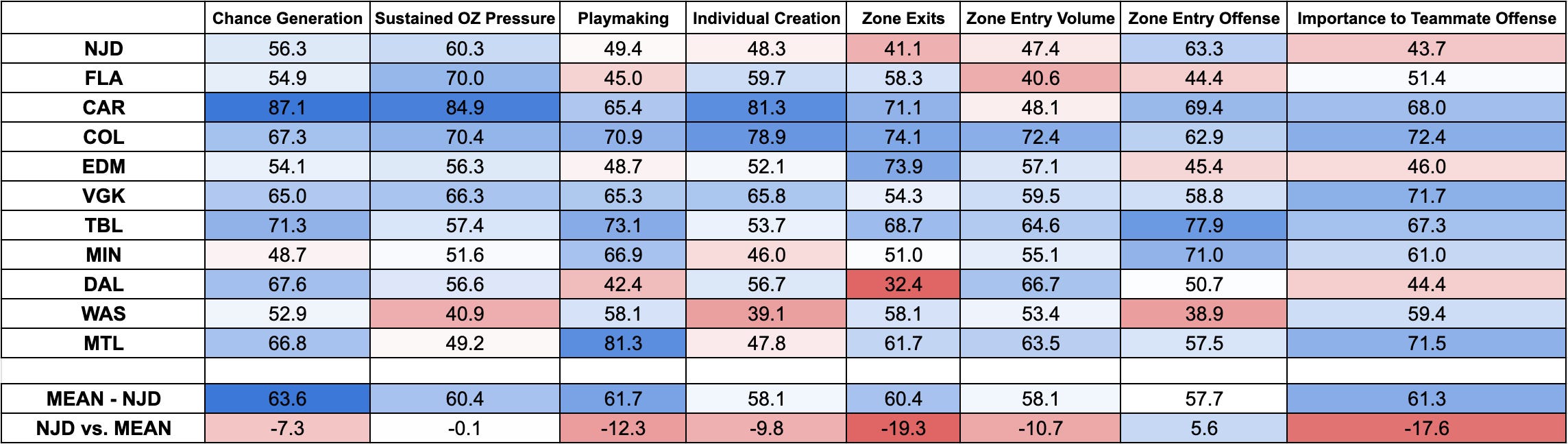
As you can see above, there is still quite a bit of work to do. Here is how the Devils rank in each category, out of 11 total teams, versus where they were in February of 2026:
Chance Generation: 7th (+3)
Sustained OZ Pressure: 5th (Unchanged)
Playmaking: 8th (Unchanged)
Individual Creation: 8th (-1)
Zone Exits: 10th (Unchanged)
Zone Entry Volume: 10th (+1)
Zone Entry Offense: 4th (+3)
Importance to Teammate Offense: 11th (-2)
Those are definitely improvements compared to where they were even five months ago — as previously noted, Mehta has done a solid job of improving the depth and trimming around the edges.
It does stand to reason, too, that some predictable development from Luke Hughes, a full off-season of rest and recovery from Johnathan Kovacevic and Brett Pesce, and an increased focus on speed and the rush up front will do them well in terms of puck movement. Still, there are too many grenade handlers on the back-end for them to truly be an effective puck-moving group. The best teams in the league have the best puck-moving defense corps — there is a clear disparity between the upper-echelon contenders and the rest of the bunch here, one that extends far beyond the grasp of systemic differences between the teams.
In particular, supplanting one of Dillon, Siegenthaler, or Kovacevic would do the organization well. It seems to be the writing on the wall, given that they have seven defensemen making at least $1.6 million and eight defensemen on one-way deals (five of whom are left-handed), that one will be moved before the season begins. That would be a sensible action plan, in my opinion.
Marginal improvement is marginal improvement, but there is always more work to be done.
I really like Dillon, but he's the only one of the non-puck movers who had a good season this past season, and I think both Seigs and Kovy have a fair liklihood of a bounce back season, so I hope it's Dillon who gets moved. I hate selling low on good players, and having it come back to bite us -.plus, I want to see if a fully healthy Seigs and Kovy pairing can recapture what they had two seasons ago. It would be great if they could be a lock down defensive pair, again.
Great stuff JP! Love this application of the LB-Hockey data. 🔥
One small note is that MoneyPuck is no longer part of the site's data sources, having been replaced with our own expected goal/value models and pipeline directly through the NHL API. So the metrics are compiled from that and AllThreeZones now!