

Devils' Prospect Update: March 4
Keeping tabs on EVERY Devils' prospect through March 4th.

Thank you, as always, for reading the Devils’ Advocates Substack! If you enjoy the quasi-daily content, please consider subscribing and sharing with your friends, family, and any Devils fan you know. It is completely free of charge and helps out quite a bit!
Recently, we reignited the Devils’ Advocates Podcast, which will feature weekly episodes chock-full of in-depth content and exciting guest appearances. They’ll be available on this Substack, but you can also listen on your favorite platforms at the following links: Spotify | Apple Podcasts
Before jumping into the prospects’ performances, making a few mental notes about the charts you’re about to see is important. Firstly, some of the leagues categorize and track data differently. For example, while most of the leagues have readily available statistics for both power-play goals and power-play assists, some leagues only record power-play goals on their public statistics pages. Some leagues don’t even have public data for metrics as basic as shots on goal.
It’s also important to define NHLe — or NHL equivalency. NHLe is a tool to project a player’s NHL viability through point totals using a mathematical model. Points aren’t everything, but in terms of prospects, they’re the best metric to project success at the NHL level. Each league has a different equivalency — one point in the AHL is certainly not the same as a point in the Canadian Juniors. On that same token, don’t be surprised to see players with similar point productions in different leagues have vastly different NHLe values. NHLe is calculated on an 82-game rate for the NHL.
Next, there’s the matter of how the data is organized. For each league — or conglomeration of leagues — I organized the data into tables with distinct headings: Age, games played (GP), goals (G), assists (A), points (P), power-play points (PPP), points per game (P/GP), shots (SOG), shooting percentage (S%), penalty minutes (PIM), and NHLe. For leagues that track it, I also included time on ice (TOI). As I previously mentioned, some leagues have power-play goals (PPG) in place of PPP, so keep an eye out for those. Goaltenders are organized into similar tables, with Age, GP, goals-against average (GAA), save percentage (SV%), their records, shutouts (SO), and goals saved above expected (GSAx), if applicable.
The players in their respective leagues are organized by draft order, from highest to lowest drafted. In addition to the tables, I’ll be posting notes highlighting notable players and/or notable performances.
Finally, there’s what I consider to be the “prospect” threshold. I considered every single player in the Devils’ pipeline who is 25 years old or younger. Chances are, if a player is older than that, they’re probably never making the NHL full-time, so I excluded them from the list.
Without further ado, let’s give some updates on the Devils’ draftees:
AHL
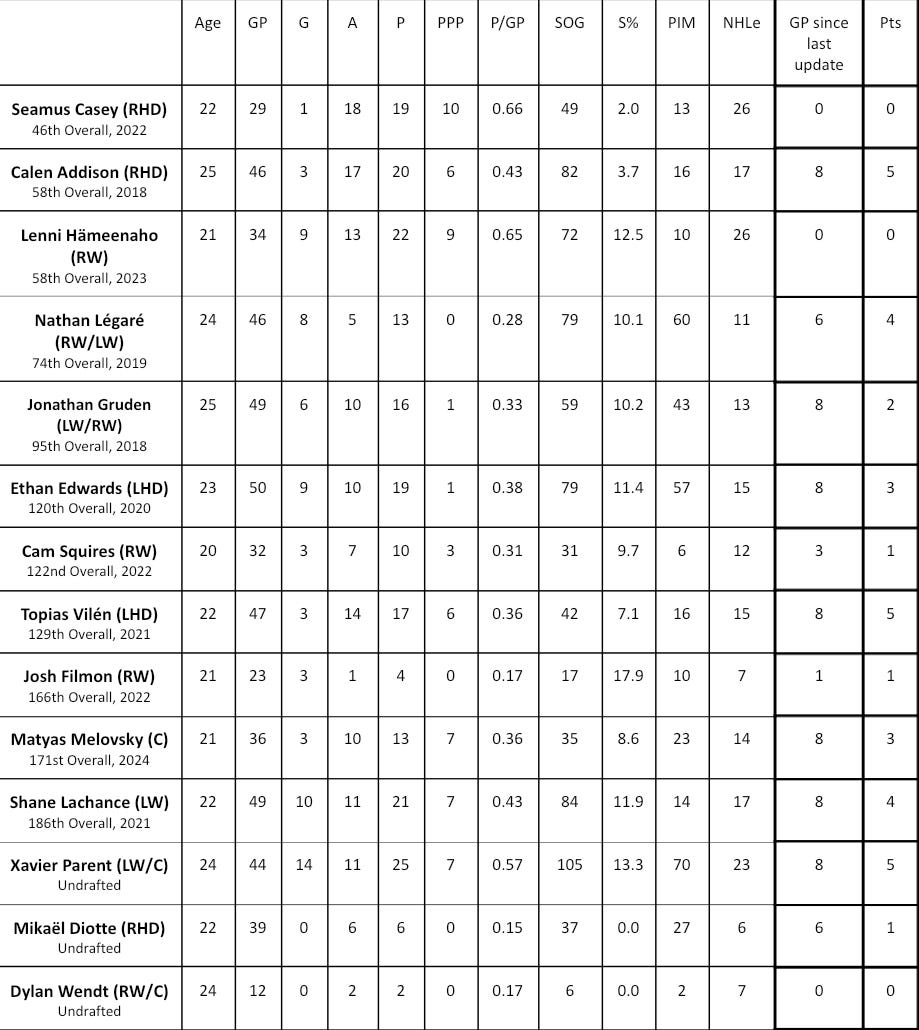
Don’t look now, but the Comets are on a three-game win streak and have gone 5-1-1 in their last seven. Of course, they’re not going to make any noise, but the team as a whole has looked significantly better of late.
Lenni Hämeenaho will probably not be on this list much longer — at this point, it’s pretty obvious he’s going to be in the NHL for the rest of the season and might not ever see the AHL again in his career. He’s looked more than capable in his time in the big leagues.
Seamus Casey is still injured, and Dylan Wendt has been moved to the Adirondack Thunder (ECHL).
The Comets’ defensemen have done well in the last couple of weeks, in particular, Topias Vilén and Calen Addison, both of whom accrued five points in their last eight games. With Casey out indefinitely, they’ve been the two to step up majorly in an offensive sense, taking on power play responsibilities acting as the primary puck-moving pair together. I’ve gradually lowered my liking of Vilén over the years, but he has previously been a productive player and I could see him turning into a seventh-defenseman in the NHL. As for Addison, he’s been a player in the big leagues before, but I’m not sure he’ll be anything but a call-up in the future.
Xavier Parent, meanwhile, has been Utica’s best forward of late, with five goals in his last three games, including a hat trick. I still believe in him as a potential fit for a fourth-line energy role, though he does have penalty-taking issues that will need to iron out if he ever wants to make the jump to the NHL. 70 PIMs in 44 games as a forward in the AHL is a concern.
The other two Utica forwards making some noise are Shane Lachance and Nathan Légaré, both of whom have totaled four points since the last prospect update. As previously mentioned, the team as a whole has looked more synergistic, and they’ve been two to benefit greatly. Whereas the Comets don’t have a bona fide stud prospect on their team anymore, there is certainly a number of players who could conceivably contribute in a fourth-line role at the NHL level, and Lachance and Légaré are two such players.
ECHL
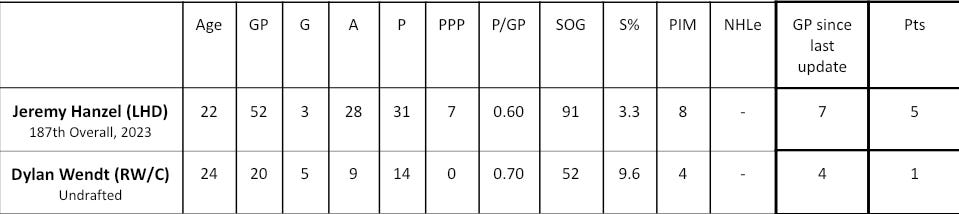
As mentioned above, Wendt was relegated to the ECHL, where he has since put up one goal in four games. He and Jeremy Hanzel are unlikely to do anything meaningful past being bottom-six/bottom-pair guys in the AHL, in my estimations.
NCAA
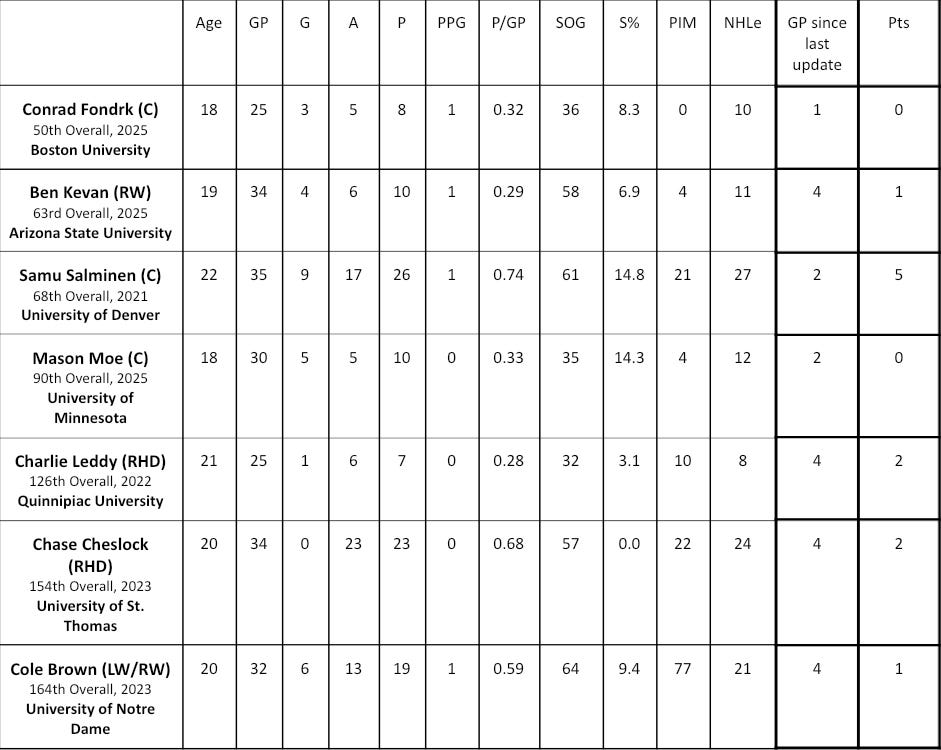
Ben Kevan has been playing significantly better hockey since getting promoted to the third line at Arizona State, even if he only tallied one point in the last four games. He’s been shooting the puck much more, too, with 12 shots on net in those four appearances, a wide improvement from the shot-per-game he was humming at practically until he got the lineup promotion. I’m excited to see where he lands next season — I’m confident that he’ll keep up this momentum and perhaps succeed far more than he has with an even more prolific role on his team.
Samu Salminen has been an absolute monster in the last couple of weeks, tallying four goals and five total points in his last two games and nine points in his last four. He’s producing a bit less this season than prior seasons, so I felt as though this explosion in production given his consistent top-six, PP1 play time was expected. Being that he is a senior now, I wouldn’t be surprised to see that he signed an AHL contract after his current season ends. He does have some upside as a potential 4C down the line, one who is defensively responsible and wins his faceoffs.
My next film room breakdown will be on Chase Cheslock, who has been as big a riser as you’ll see in the prospect world this season. The right-handed defenseman has turned into a true top-pairing, two-way guy this season, and is looking the part of a potential NHLer down the line, too. His 23 assists is tied for fourth in the entire NCAA among defensemen.
USHL

David Rozsíval had a strong couple-week stretch in the USHL where he looked like the Gamblers’ best skater, and, though the production has certainly dipped, I’m not wholly convinced that that stretch was a fluke. His puck protection skills are impeccable — at least at this level — and he is able to pick corners with some regularity from mid-to-short distance. I think he’s going to be one of the better producers in the USHL next season.
Russian Leagues
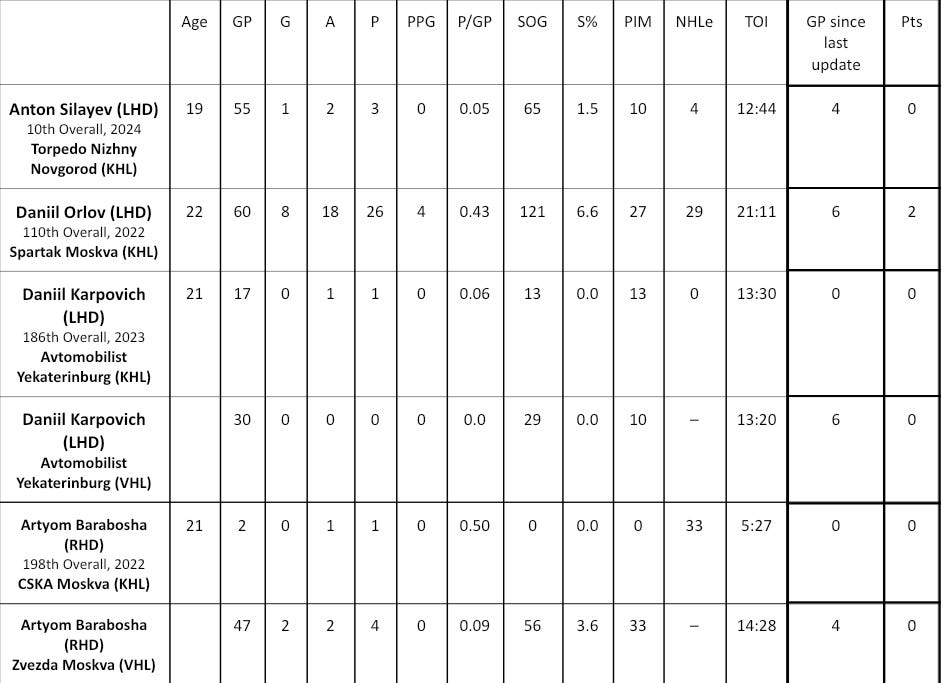
Another two weeks, another point-less stretch for Anton Silayev, who has seen his ice time diminish consistently as well. It’s whatever at this point — there are only a handful of games left in the KHL regular season, and his team is firmly in a playoff spot. It’ll be intriguing to see if he gets increased playing time in the post-season. It’ll be even more intriguing next season, when he’s likely in the AHL.
Daniil Orlov has slowed a bit since his blistering start to the season, but the transformation this season into top-pair defenseman has been a fun watch. He’s an incredible neutral zone defender, all due to his four-way mobility, and he can certainly contribute heavily to zone exits and transitioning the puck up-ice. His contract ends in 2028, though, so it will still be a while before we see him on North American ice.
Other European Leagues
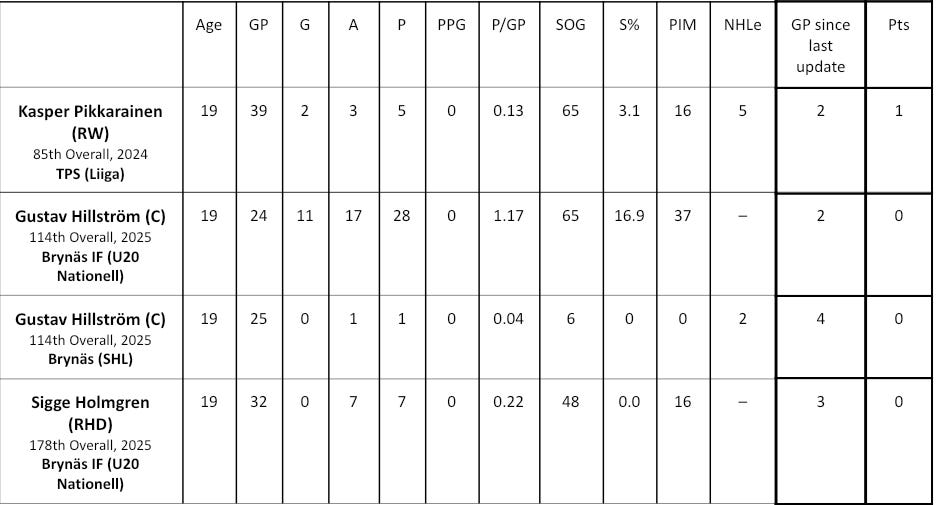
Gustav Hillström maintains the only other European prospect worth monitoring, and even he is having a strange second half of his season. He split time between the SHL and U20 Nationell, but only actually played in two games (logging less than 10 minutes in each) in the SHL. I’m not taking a whole lot of stock in his end-of-year statistics, simply because he’s getting jostled around quite a bit at the moment. He should be a full-time SHLer next season.
Goaltenders
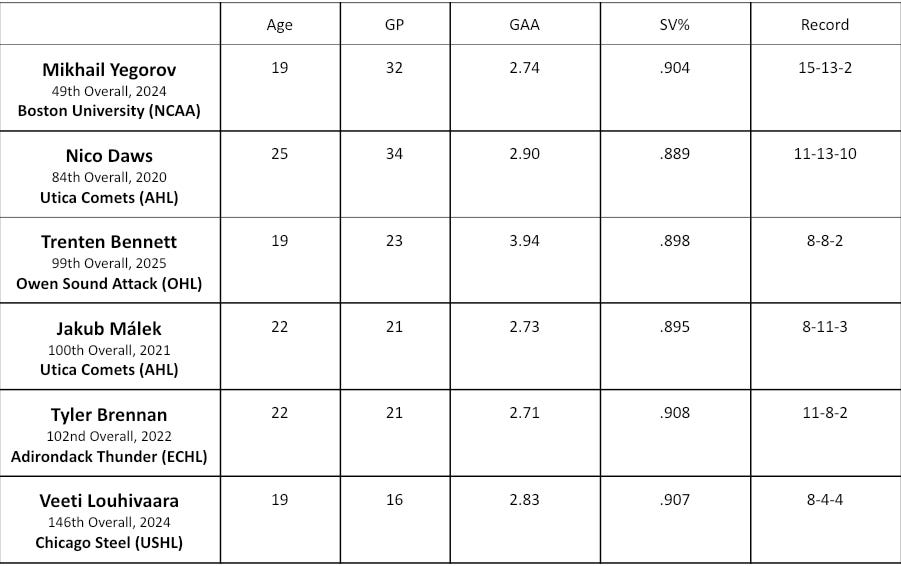
Mikhail Yegorov and BU won both of their games since the last pipeline update, with the goaltender allowing just two goals on 54 shots against their archrival, Boston College. It was an excellent showing from Yegorov, who made a number of high-danger saves behind a defense that, while they have struggled for much of this season, looked a bit sturdier last weekend.
The Comets’ goaltenders, Nico Daws and Jakub Málek, have been decent of late. The latter has appeared in four games, and, outside of one true stinker in which he gave up four goals on 13 shots, played well. In the other three games, he saved 73 of 77 shots against him (a .948 save percentage). Daws has only given up seven goals in his last five appearances, with a .939 save percentage in that time. Like I said, Utica has actually been watchable in recent weeks.
Veeti Louhivaara’s move to the USHL was a smart one, as the young netminder has since committed to the University of Connecticut for next season. There, he should fight for the starter role in the hardest conference in college hockey.
The next iteration of the Devils’ pipeline update will be (approximately) two weeks from now. Stay tuned!