

Devils' 2026 First-Round Draft Profile: Ethan Belchetz
Evaluating what Ethan Belchetz brings to the table as a potential target with the 12th overall pick in the 2026 NHL Entry Draft.

Thank you, as always, for reading the Devils’ Advocates Substack! If you enjoy the quasi-daily content, please consider subscribing and sharing with your friends, family, and any Devils fan you know. It is completely free of charge and helps out quite a bit!
Consider checking out the Devils’ Advocates Podcast, which features weekly episodes chock-full of in-depth content and exciting guest appearances. They’ll be available on this Substack, but you can also listen on your favorite platforms at the following links:
It’s that time of year, folks.
The Devils did not win the draft lottery last night, instead staying true to the 85.7% probability that they stayed put at 12th place.
I have said in the past, and I certainly hold the opinion now, that the Devils should be looking to trade the 12th overall pick in a package for an impact player who fits the age window of the core’s pieces. Someone like Robert Thomas, Matthew Knies, or Brady Tkachuk should he become available.
However, I would be remiss not to lay out some potential draft-day targets with the Devils’ selections in the event that they are unable to get a trade done surrounding the pick. There are certainly some strong NHL-projectable players available with the pick, even in a class that doesn’t necessarily excite me a whole lot.
Beyond just their first-round pick, the Devils have their second, fourth, fifth, and sixth-round pick in the draft this season, and I’ll be on a mission to tell you who I think the Devils could — and should — target with the picks they have. Consider this the first part of a many, many-part series detailing appealing targets for every round the Devils select in.
The first-round targets will come in no particular order, but you’ll certainly get a sense of who I want the Devils to pick by the end of the series, where I’ll have a full mock draft detailing who I want the Devils to pick and why. I digress.
First up on the docket is Ethan Belchetz of the Windsor Spitfires. The 6’5, 225-pound power winger logged 59 total points in 57 games in the OHL in a top-line, top-power play role. At a couple of points in the beginning of the season, he was a consensus top-five pick, but has slid back by virtue of slowing down his scoring pace a good bit and suffering a broken left clavicle in March that held him out for a good chunk of the 2025-26 season. Still, he presents as an appealing option if the Devils want to add both skill and size up front, with a couple of appealing traits and drawbacks to his game to boot.
By the Numbers
Rankings: #7 by EliteProspects | #13 by Craig Button | #5 by FloHockey | #13 by Scott Wheeler | #13 by SMAHT Scouting | #13 by McKeen’s Hockey | #14 by Yours Truly
Size: 6’5, 225 Pounds
Production: 34 Goals & 25 Assists (59 Total Points) in 57 OHL Games
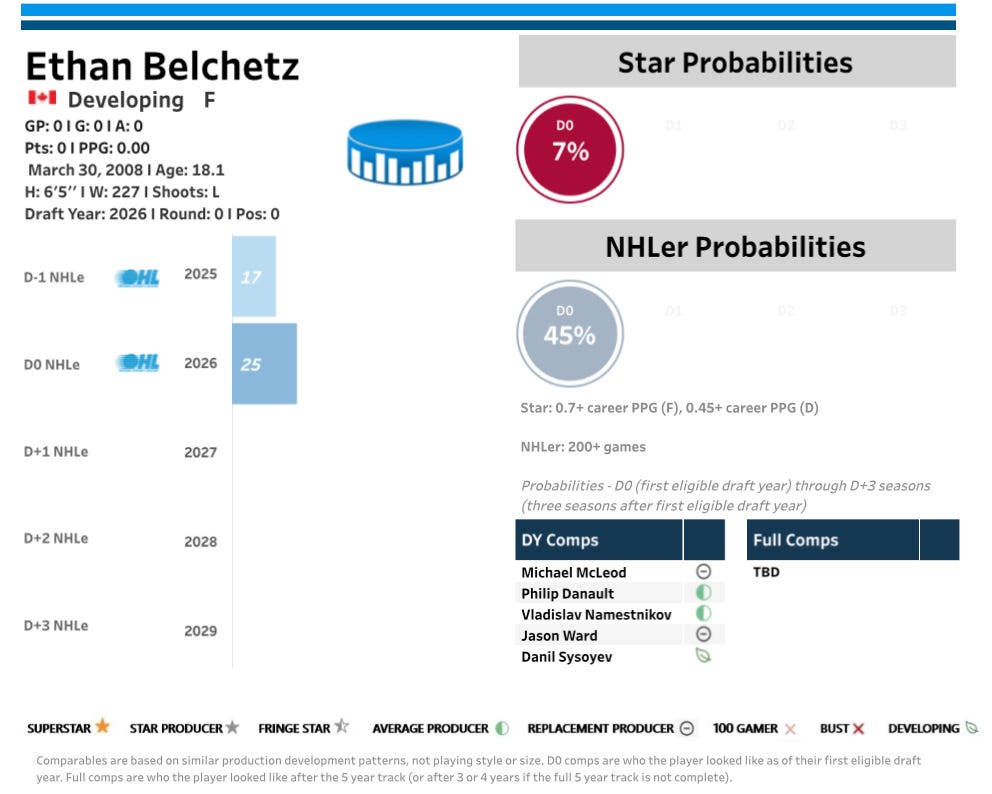
Frankly, Belchetz’s statistical profile is somewhat weak in comparison to some other targets who will presumably be available at the 12th overall slot. His production pales in comparison to many names well below him in the list, with the 18-year-old ranking 2nd among draft eligibles in the OHL in goal scoring, 6th in total points, and 8th in points per game (1.04). This gives him a pedestrian star probability of 7% in HockeyProspecting’s model, a number that honestly grades out pretty poorly for this slot in the draft.
That said, his underlying profile is pretty strong, so even if the production itself isn’t there, Belchetz should still be getting some statistical flowers:
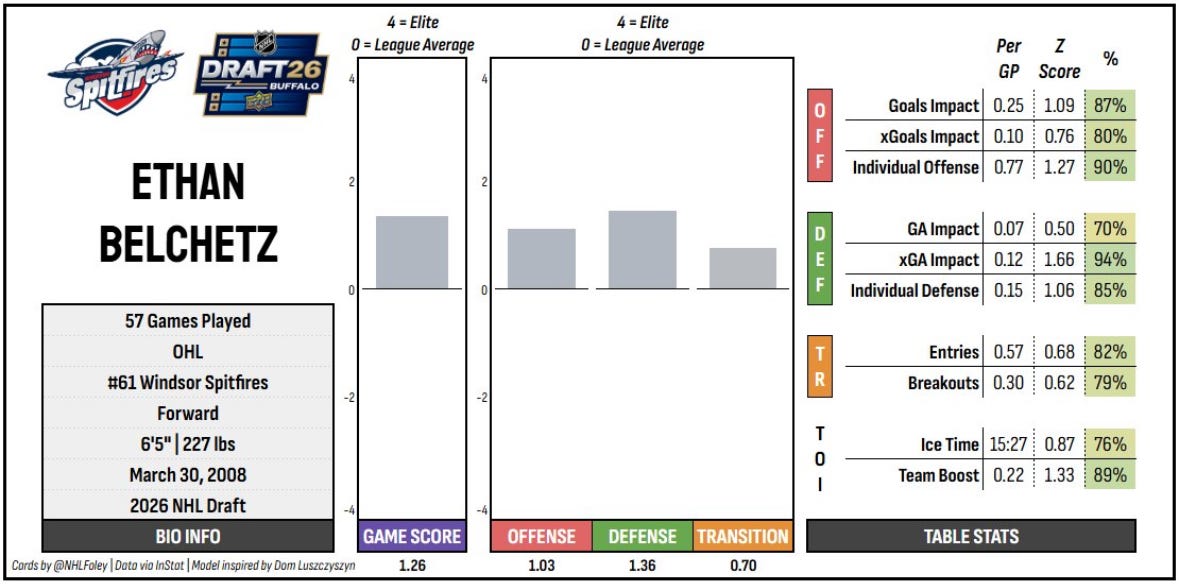
This visualization, courtesy of Gabe Foley, uses InStat to track expected goal (xG) impacts, transition statistics, and individual events on both sides of the puck. In that regard, Belchetz grades out well both offensively and defensively. His individual impact in those aspects of the game ranking in the 90th and 85th percentile, respectively, absolutely tracks with the eye test, as we will get into below:
Evaluating Belchetz’s Tools
Skating
As you would expect from a player of his size, Belchetz isn’t the fleetest of foot, which is arguably the biggest knock on his overall game. He lacks consistent separation speed, and, though he has shown flashes at points of being able to get loose from defenders with crossovers and burst ability, he’ll need to work on his leg strength to become an average skater.
That said, for his size, he does possess somewhat abnormal agility. Belchetz can knock defenders who are pressuring him loose of coverage through quick turns and strong edges:
Beyond just adding necessary foot speed, Belchetz will need to add a bit more pace in his game when he is participating on offense or in transition. It feels like, at times, he coasts to where he needs to be rather than rushing to get there and putting in true effort all the time. That’s a mentality thing rather than an ability thing, though, which should mean that it is easily fixable.
Shooting
If there is one offensive calling card to Belchetz’s game, it’s his shot.
In particular, his one-timer is powerful and compact, and he is able to get it off at any angle while under duress or pressure. This had been demonstrated time and time again over the course of his 2025-26 season, particularly on the man-advantage:
That doesn’t mean his wrist shot isn’t electric, too, though — it certainly is. Belchetz’s release is pretty dynamic, being able to fool goaltenders outright from mid distance. Where his stride is questionably strong with regard to how much speed he is able to build up, he does generate a ton of power from his legs in his shot mechanism. He picks corners comfortably from all angles and distances, and can shoot through traffic and while under pressure without missing a beat.
From in-tight, Belchetz is able to lift the puck quickly and effortlessly, making him a threat from right around the goalmouth as well. That’s somewhere he’s likely to be often as an NHLer, so that ability is a must in terms of jamming home rebound opportunities.
Hockey Sense & Playmaking
I don’t think Belchetz gets enough credit for his hockey sense or passing ability — most of the talk now is on his two-way game and his shot. That said, I think he can keep pace mentally with top-six players quite comfortably. He knows how plays are going to develop before they happen, being able to perfectly read his teammates’ and opposition’s body language, position on the ice, and orientation and acting proactively while strategizing around those factors.
Belchetz can also thread passes through traffic with consistency, being able to sauce passes through multiple layers of defense when there isn’t a clear pass option to go to. I’ve noticed that his passing on the rush is a strength, using the threat of his shot to bait goaltenders into assuming it’s coming before doling out a perfect pass through a defender’s legs or body instead. Even when not in a 2-on-1, though, Belchetz loves to draw traffic to himself before getting a pass through said traffic:
Belchetz’s off-puck smarts are excellent, too. He knows where to be, even if he struggles at points with pace and getting there in a timely manner. For a big player, he genuinely excels at getting into open ice undetected, shocking me with how perpetually able to sneak into a shooting lane he was throughout the course of his season. Many of his goals came on sequences just like this one, where he catches the puck mid-stride while streaking into the slot:
Puck Skills
For a big man, Belchetz does have a good arsenal of moves and the wherewithal to use different ones in different circumstances. This isn’t to say that he can deke and dangle around multiple defenders, but he can get by comfortably in one-on-one situations and when the play calls for it off the cycle:
More than his dangles, Belchetz’ puck skills are shown clearly in his tipping and deflection ability. When he positions himself at the netfront — which he does often — he is a threat to get a puck on net from just about anywhere. Of course, unrelated to his puck skills, he is genuinely excellent at getting to rebounds (both his own and rebounds from others), but what impresses me the most about his netfront ability is his hand-eye coordination.
Defensive Play
Entering the season, prior to getting familiar with any of the draftees, I earnestly thought Belchetz was the typical one-dimensional big forward with a big shot, but he is genuinely one of the more defensively mature players in this class.
In particular, I’ve always been impressed with how hard he works to disrupt the opposition on the backcheck. Whereas his on and off-puck pace can be questionable in the offensive zone or in transition, I’ve never really found myself questioning his compete level on the defensive side of the puck. He is aggressive in pursuit of loose pucks in his own end, taking personal offense at the fact his team does not have possession.
The more impressive part, to me, is his multi-dimensionality when it comes to how he approaches retrieving pucks back. Of course, at times, it’s through imposing his physicality. Others, it’s through positioning and stickwork, with a puck-hound ability to sniff out passing lanes and put himself in position to generate a turnover.
Physicality
As you would expect from a 6’5, 225 pound 18-year-old power forward, Belchetz is reasonably comfortable playing physical hockey. He was penalized on several occasions for borderline hits during the 2025-26 season, which is both a product of playing the body aggressively and being significantly larger than his competition — at times, he would inadvertently make head contact just by proxy of being so much bigger than the player he was hitting.
A no-nonsense player, Belchetz also has absolutely no problem mixing it up when he thinks his teammates have been wronged or targeted with an illegal hit:
At the end of the day, there is some value in having a player of this archetype. Physicality isn’t the be-all end-all that some think it is, but it does have its place and players who are able to generate offense through physicality are generally coveted, especially when said player also has skill to boot. One of those places is around the netfront, which, as we’ve established, Belchetz is very effective. On top of his hand-eye coordination, boxing him out of the goalmouth is a nigh-impossible task for most defenders, as the hulking forward simply outmuscles them most of the time. Elsewhere, he is an excellent forechecker for the most part, using his size to his advantage when his speed doesn’t hamper his ability to get to the puck at a similar time to the defender.
All that said, I actually think Belchetz could use to be a bit more assertive physically. It’s not that I want him to be running all over the place like a pinball, because I don’t think that would be the best use of his overall skillset, but I do think he could be a bit more present, for lack of a better term. He could use to be meaner along the boards — that would serve him well in winning battles.
Belchetz isn’t the prototypical 6’5 power forward that Hockey Men flock to far too early in the draft — there’s certainly some substance here. I had him ranked 14th on my personal list, one predominantly built on upside, but the Devils would be in a good spot if he was their top prospect up front. He checks most boxes, with 30-plus goal upside and the offensive hockey sense and playmaking ability to chip in another 30 assists year after year while playing a physical, bruising game.
That said, the concerns about his skating are legitimate, with periodical lapses between what his head and feet want to do hindering his ability in transition. He could also serve to become more physically imposing and add a bit more pace and consistency to his game. If it all pans out, he certainly looks like a player who could contribute meaningfully in a top-six capacity. At worst, he should be a third-liner with defensive prowess and goal-scoring, PP2 upside.
NHL timeline: 2028-29
NHL comparable: Juraj Slafkovský
Stay tuned for tomorrow’s piece on another potential target!
All videos in this piece came from the OHL on FloHockey.
Appreciate the in-depth analysis. Is he a younger, bigger Stefan Noesen?
I dont think he gets to 12. That said, this would be my pick unless a consensus top guy slips down for some reason. I love the NHL comparisons, although I am frustrated sometimes by the fact that older players are not used for them, I would like to see a floor comparison as well. So he is Slafkovsky high end and Tsypiklov - low end (for example)