

Thank you, as always, for reading the Devils’ Advocates Substack! If you enjoy the quasi-daily content, please consider subscribing and sharing with your friends, family, and any Devils fan you know. It is completely free of charge and helps out quite a bit!
Consider checking out the Devils’ Advocates Podcast, which features weekly episodes chock-full of in-depth content and exciting guest appearances. They’ll be available on this Substack, but you can also listen on your favorite platforms at the following links:
The New Jersey Devils acquired the 35th overall selection in the 2026 NHL Entry Draft by trading away Simon Nemec for a haul of high-value picks. At the draft, they moved back two spots — from 35 to 37 — and gained the 119th overall pick in the process.
At 37, they went a bit off the board and selected forward Matias Vanhanen from the Everett Silvertips. The 18-year-old barely registered into this draft as an overager, being born less than a week too late to be a first-year eligible. He went undrafted in 2025 in part due to his size — at that time, he was 5’9 — but has since grown a couple of inches and lit up the WHL, making him a player on many organizations’ radars.
Let’s discuss what Vanhanen brings to the Devils pipeline from a toolkit perspective, as well as projecting the type of player he can become at the NHL level:
By the Numbers
5’11, 176 Pounds | 21G + 66A (87TP) in 62 WHL Games
Vanhanen absolutely lit up the WHL this season while playing on one of the best lines in the CHL, putting up a team-leading 87 points (21 goals, 66 assists) in 62 games. In the playoffs, he was their second-most productive player, with 24 points (12 goals, 12 assists) in just 18 games. His 87 points were ninth-most in the WHL, and his 66 assists solely trailed Markus Ruck. When looking at Vanhanen’s underlying numbers, things only get more positive:
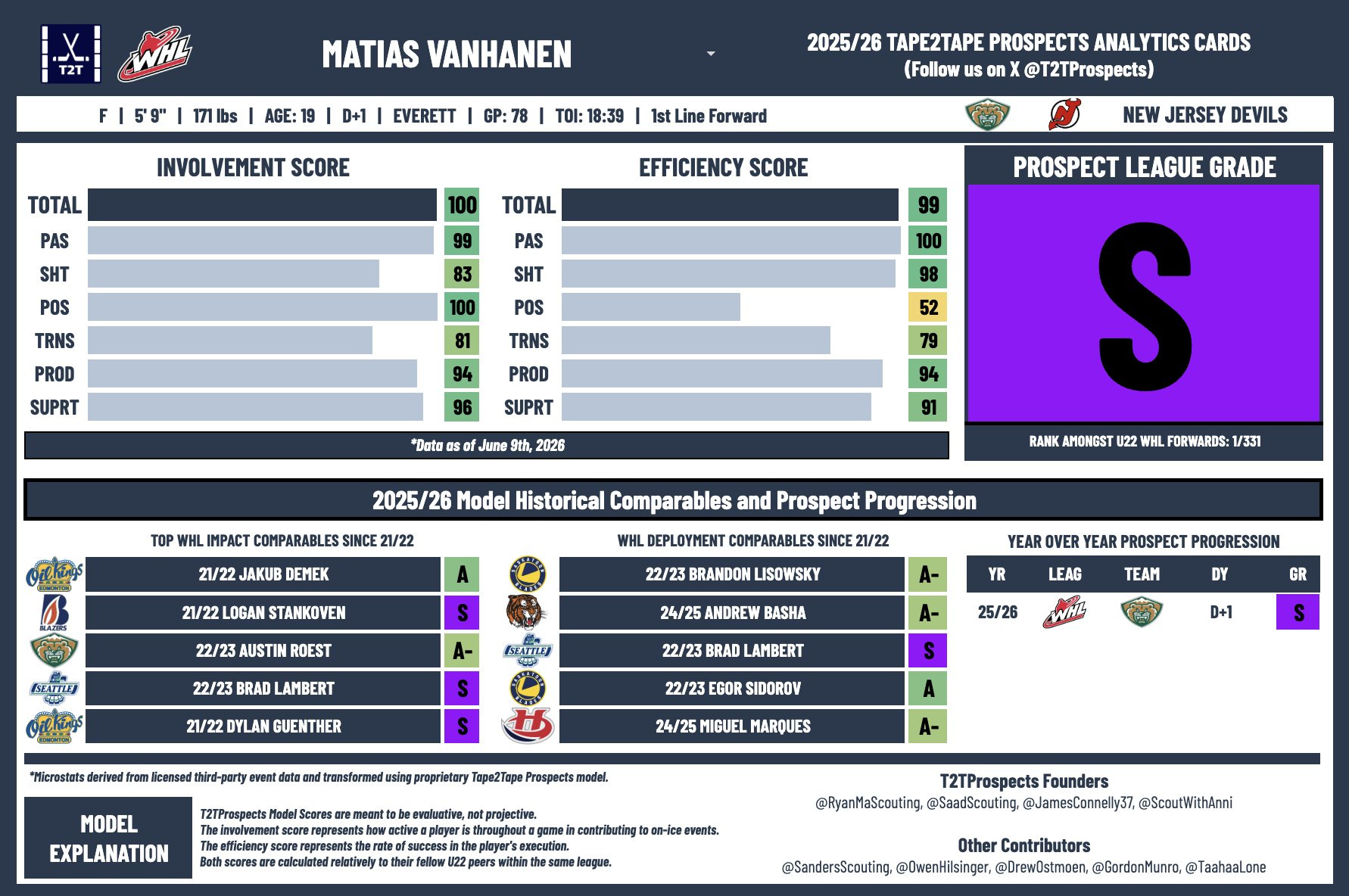
Vanhanen ranked first of 331 WHL forwards in terms of microstatistics, giving him similar profiles to the likes of Logan Stankoven and Dylan Guenther, two players currently playing at a high level in the NHL. Vanhanen does just about everything right in all three zones, being in the 100th percentile for involvement with the play and in the 99th percentile for efficiency according to Tape2Tape’s model. InStat is similarly high on him:
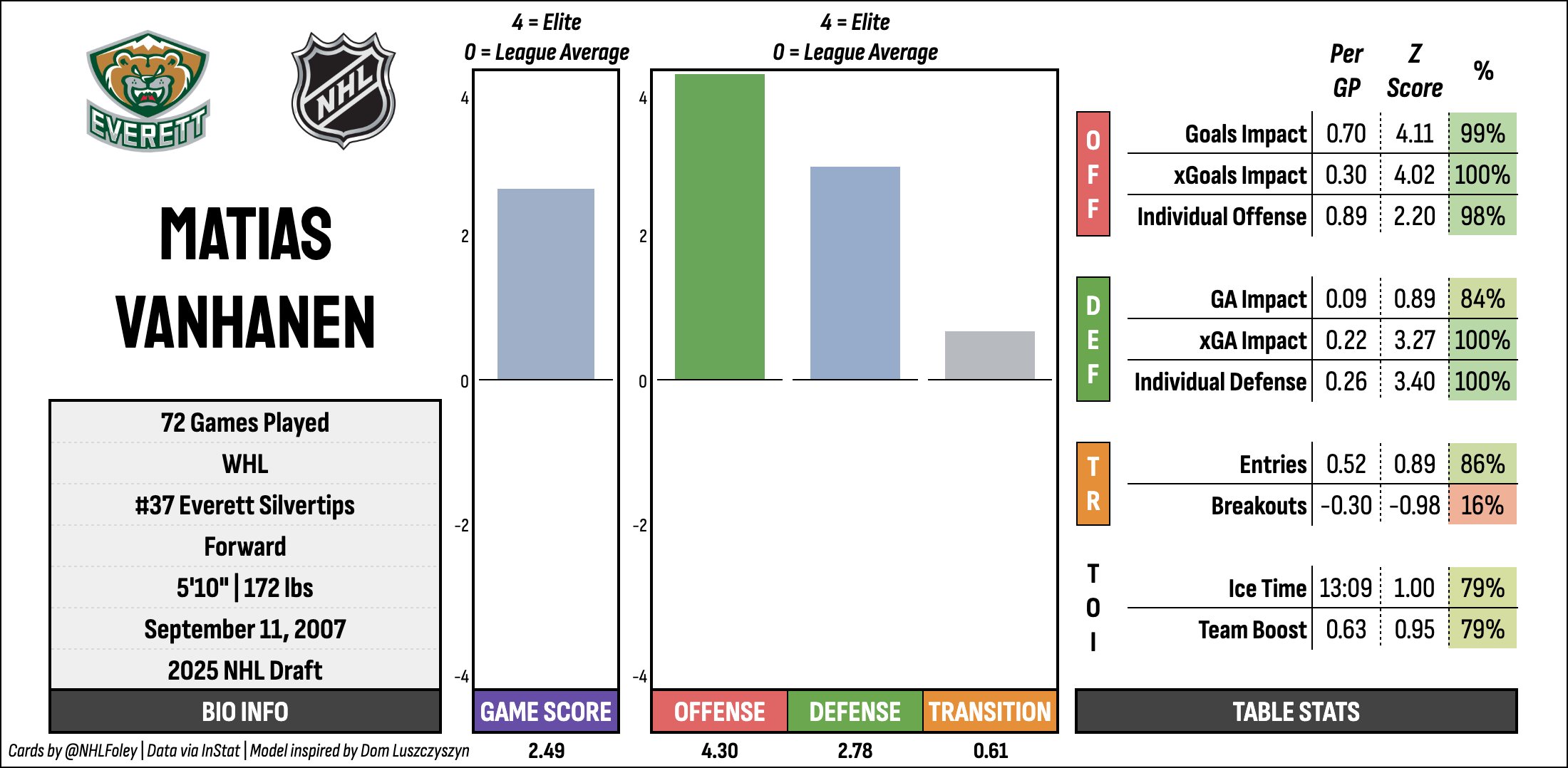
Most of Vanhanen’s dominance comes from within the offensive zone, where he ranked in at least the 98th percentile in all tracked statistics. His defensive game was superb metrically as well, as evidenced by 100th percentile finishes in expected goals against (xGA) impact and individual defense, and though he was minimally effective at breaking the puck out with the puck on his stick, he was a proponent of zone entries and often facilitated breakouts through passing. All told, this is a prospect with a truly special analytical background.
Skating
Vanhanen isn’t a burner by any means, with somewhat average speed and average acceleration. He won’t beat a defender 1-on-1 using his legs, unless it is by virtue of his edgework — he can shift weight between his skates quite quickly and, as a result, can turn on a dime. For the most part, he uses this to attack the middle of the ice while his team is on the cycle, drawing in defenders before peeling back (and subsequently opening up gaps in coverage for his teammates). Off the rush, though, defenders can occasionally close gaps on him quickly, which is something that Vanhanen is unafraid of simply because he has such great playmaking vision.
Shooting
I’ve read a good few reports citing Vanhanen’s shooting abilities as subpar, and I must admit that I don’t quite understand why. His wrist shot mechanics are, though admittedly not world-beating, solid, with an ability to catch-and-release a pass and get it on net quickly and with power:
Though Vanhanen’s wind-up is somewhat predictable, he is accurate and powerful enough with his wristers to occasionally beat goaltenders from distance, though it isn’t a commonality:
Vanhanen’s one-timer is pretty strong, too, though it could use a bit more oomph behind it. It’s accurate, and his positional IQ makes it all the more threatening simply because he finds the lanes to use it more often than someone with an average understanding of weaponized positioning. As his legs fill out to match his newfound height, more power will be added to his shots as a whole, and his one-timer will become only more threatening.
I would grade Vanhanen’s shot as more “average” than below.
Hockey Sense & Playmaking
This facet of the game is where Vanhanen truly shines — he has a top-10 offensive IQ in the entire draft class, and I would struggle to name on one hand the number of draftees who are a better passer. The name of the game for him is in finding cross-ice or cross-traffic passes, which he can execute from quite literally everywhere on the ice. If he’s along the perimeter, at the top of the zone, or from the inner slot, he finds a way to get the puck to his linemates with passes that magically make their way through coverage unimpeded, with the end goal of making the goaltender move side-to-side.
Enjoy the following three clips of Vanhanen making magical cross-ice passes:
Vanhanen executes such plays with extreme confidence in his passing chops, which come as no surprise considering how effortlessly he can dole out saucer passes over sticks, on-ice tape-to-tape passes through bodies and sticks, bank passes, and backhand passes. There’s truly nothing that isn’t in his playmaking arsenal, and those are only further exacerbated by his clever usage of his edges, head fakes, and peel-backs that draw defenders to his location on the ice.
When he doesn’t have the puck on his stick, Vanhanen is still somewhat dynamic, understanding the intricacies of space and timing and how to exploit them to put his team in a better position. He can find gaps in coverage with ease, and his vision of the ice extends into predicting defenders’ positions.
This part of the game is what makes Vanhanen such a tantalizing player. With the puck on his stick, he’s legitimately game-breaking as a passer. Given his somewhat limited (i.e. average) skating chops, most of this dynamism comes off the cycle.
Puck Skills
Vanhanen almost certainly has the capabilities to pull out some interesting dangles, but in my dozen or so viewings of him since he was drafted, I found that most of his moves were simple. Toe drags to get a shot or pass off around a defender are commonplace within his game, and he executes simple side-to-side dekes to get out of danger if he gets crowded by multiple defenders, but the high-difficulty moves are fewer and further between. That doesn’t need to be a part of his game, though, considering that he relies almost exclusively on his high-end smarts rather than his average-to-above-average skill.
Defense
Vanhanen is engaged defensively, mostly through the neutral zone as he attempts to pickpocket defenders and start a counter-attack the other way. He’s particularly effective as a breakout passer once he does get the puck in his own zone, relying more on his passing chops than his acceleration and speed to clear the zone. His positioning is fine — where he truly shines defensively is in his stickwork. Vanhanen is calculated with his stick checks and their positioning, never getting it caught in a carrier’s skates (and thus staying out of the penalty box) while prying the puck loose and subsequently pouncing on it.
There is more work to do with his defensive game, as there always is, in the sense that he can likely be a bit more tenacious along the boards and have a higher defensive motor, but the blueprint for d-zone success is there. Vanhanen is simply too smart to be a defensive liability at any level. There’s a reason Everett put him out in defensive situations somewhat frequently this past season.
Physicality
Vanhanen isn’t an uber-physical player by any means. He won’t throw open-ice hits and he can lose a good chunk of his board battles, but that isn’t his game whatsoever, and he will always be best served having a heavy forward as a linemate. This doesn’t mean that he is unengaged on the forecheck, though — he employs a similar style to Jack Hughes and Jesper Bratt in this regard in the sense that he outwits the opponents into turning the puck over. I digress.
Occasionally, Vanhanen will throw out a proactive check to establish body positioning along the perimeter of the ice, and I think that part of his game will only develop more as he continues to put on weight. He’s not shy of contact; it’s just that he understands that the most successful part of his game is independent of it.
All told, Vanhanen’s selection at 37th overall was a wise one, a somewhat off-the-grid bet on extremely projectable playmaking talent. As evidenced by Mehta’s reaction to getting him, this is a player the Devils should be extremely excited about, and for good reason. With some development in his shot and a bit of advancement in his physical game, this is a player who comfortably projects to an NHL middle-six as a playdriving cycle player. No one really knows quite yet where Vanhanen will play in 2026-27 — it could be that he spends another year with the Everett Silvertips, it could be that he has college offers on the table, or it could be that he spends time in the AHL, thanks to a new CHL rule that allows one drafted 19-year-old per team to play in said organization’s AHL affiliate. I would prefer the college or AHL route, simply because he’ll be playing against real competition rather than stomping on players younger than him, but there’s no way to tell at this point.
Either way, Vanhanen was an excellent pick for New Jersey in the second round, with an absolutely tantalizing skill set.